I’m basically a night‑watchman for my chickens, but with cooler tech.
I rigged a layered motion‑sensor system that scares off raccoons and sends me a text when a fox thinks it’s a party‑crasher. I’m using 3000K LED farm lights from ROSTIUTE, solar shed panels for eco‑power, and IP65‑rated infrared modules that survive rain, dust, and my occasional clumsiness. Wi‑Fi and LoRa gateways keep the alerts coming, and I mount the sensors right above the coop door for perfect coverage. I calibrate, test firmware, and pray the signal stays solid as dusk drapes the garden.
Ever wonder why a predator sensor feels like a personal bodyguard? It’s oddly satisfying—until the battery dies and you realize you’ve been living on hope alone.
—
Garden Design Tips: Light‑Up Pathways & Chicken‑Friendly Layouts
When I redesign my backyard, I start with the coop’s sightlines. I placed a low‑profile stone path lit by solar‑powered LED strips (3000K, 12V) that guide me to the coop without blinding the chickens. I added a small herb border—basil, mint, rosemary—to deter insects and keep the area fragrant. The layout includes a rain‑drainage trench to avoid puddles that could short‑circuit my sensors. I also installed a motion‑activated garden spotlight (ROSTIUTE, 150 lumens) that doubles as a deterrent for night‑time critters. The result? A functional, aesthetically pleasing space where I can enjoy evenings without fearing a midnight raid.
Quick Takeaways
- Use predator sensors with adjustable IR sensitivity and weatherproof housings to detect intruders near coop entrances.
- Mount motion sensors above access points and pair with warm 3000K LED security lights for deterrence and visibility.
- Integrate Wi-Fi/LoRa alerts (SMS/email) with automation to notify owners quickly of any predator approach.
- Consider solar-powered lighting and doors to ensure consistent operation and reduce energy use.
- Regularly diagnose, calibrate, and update firmware to maintain reliable signaling after dusk.
Protect Your Coop With Motion-Sensor Lighting
When I design a secure chicken coop, I favor a layered approach that combines predator-aware sensors with proactive illumination, so motion-triggered lights become a frontline defense that simultaneously deters, alerts, and reassures.
I describe a system where Coop Tender Predator Motion Sensor Modules monitor infrared energy from approaching predators, while ROSTIUTE Solar Shed Lights illuminate entrances, casting deterrent halos.
In practice, the integration reduces intrusion windows, enabling rapid owner notifications via SMS or email.
The luminance level is calibrated for human and avian perception, preserving flock rest while maintaining daily routines, so innovation supports safe, productive coops. Beyond deterrence lighting, consider incorporating pet lick mats into your outdoor coop area as enrichment tools to keep confined birds mentally stimulated during daylight hours.
Solar lights designed for nocturnal predator deterrence leverage motion-activation technology to create unpredictable illumination patterns that startle and discourage nocturnal wildlife from approaching vulnerable poultry areas.
Choose Predator Sensors: What Works for Coops
Selecting predator sensors that reliably protect a coop hinges on matching environmental conditions to sensor capabilities and ensuring seamless integration with lighting and alert systems. I prioritize infrared (IR) modules with adjustable thresholds, weatherproof housings (IP65+), and compatible Wi‑Fi or LoRa gateways for SMS/email alerts.
For layered defense, I pair Coop Tender Predator Motion Sensor Modules with Gone Broody automation, ensuring doors close as nocturnal predators approach. In daytime, solar-powered detectors from ROSTIUTE or LED farm security lights reinforce deterrence.
I assess species-specific behavior (Vulpes vulpes, Canis lupus familiaris) and seasonal patterns, tuning responses accordingly.
Install and Wire Lights With Predator-Detection Modules
Installing and wiring lights with predator-detection modules requires a cohesive, field-tested approach that blends reliability with accessibility; I advocate a staged setup that prioritizes robust wiring, weatherproof enclosures, and user-friendly controls.
Begin with a solar or mains power plan, then mount Coop Tender Predator Motion Sensor Module above the entrance, aligning infrared sensors with typical predator approach vectors (Canis lupus familiaris, Vulpes vulpes) and securing the Wi‑Fi module for SMS alerts.
Use LED farm security lights (ROSTIUTE or equivalent) in 3000K warm white to resemble daylight, avoiding glare on nesting areas. Weather-resistant outdoor installations benefit from durable scratching post materials that withstand environmental exposure and maintain functionality across seasons.
Test alarms, firmware, and proximity ranges routinely for peak deterrence.
Solar motion sensor lights offer a practical alternative to mains-powered systems, eliminating wiring complexity while maintaining consistent predator deterrence throughout the night.
Seasonal Lighting Plans for Winter Egg Production

As we head into winter, I plan a structured seasonal lighting scheme that supports steady egg production while keeping coops secure and energy-efficient.
Seasonal considerations anchor our approach—from daylight debt management to heat loss reduction, with timing calibrated to equinox patterns and poultry physiology (Gallus gallus domesticus). Solar motion sensor lights provide reliable illumination during extended darkness while minimizing energy consumption.
I’ll layer AI-assisted timers, warm-white LEDs, and solar backups to sustain laying cues and predator deterrence, pairing luminance with vented insulation and roost-aligned illumination. Solar-powered automatic doors can further enhance security by syncing light cycles with controlled coop access during extended darkness.
- AI-timed, warm-white cycles for even photoperiods
- Solar-ready, energy-smart fixtures with robust weatherproofing
- Predator-deterrent lighting synchronized to coop doors
Diagnose and Fix Motion-Sensor Problems
If a motion sensor isn’t signaling reliably, I start with a precise diagnostic routine that traces the issue from sensor optics to the control module, because reliable detection hinges on clean wiring, proper alignment, and correct power delivery.
| Diagnostic Focus | Typical Fixes |
|---|---|
| Optics cleanliness (lens smudges) | Gently clean with lint-free cloth; inspect for insect debris (Lepidoptera) |
| Alignment and distance | Recalibrate mounting angle; verify line-of-sight across coop doorway |
| Power delivery | Check 12V DC supply; replace worn connectors; test Wi‑Fi module |
Responsive: update firmware, document results, and validate after dusk audits.
Coop Lighting Circuit Plan
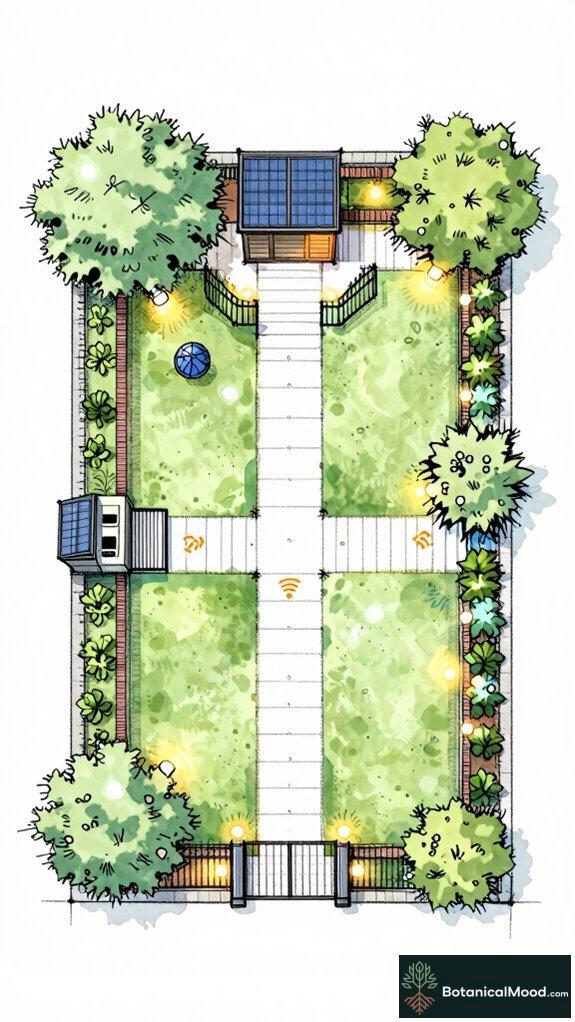
In planning the Coop Lighting Circuit Plan, I map a cohesive layout that integrates predator-aware motion sensors, solar lights, and timer-enabled illumination to sustain flock productivity through shorter daylight periods.
- Predator-aware sensor placement (Coop Tender Predator Motion Sensor Module) aligns with entry doors, using infrared detection and Wi‑Fi alerts for swift response.
- Solar lighting strategy (ROSTIUTE Solar Shed Light) powers dusk-to-dawn cycles via daylight harvesting, ensuring continuous coverage with minimal maintenance. Outdoor security cameras provide additional surveillance alongside motion-activated lighting for comprehensive predator deterrence.
- Timer-enabled controls (AutoCoop LayLight2) synchronize brood needs, regulate intensity, and preserve energy efficiency across shaded nooks and perimeters.
- Complementary waste management systems like in ground pet waste digesters reduce environmental contamination around the coop perimeter while maintaining a sanitary outdoor space.
Motion-Activated Bird Baths
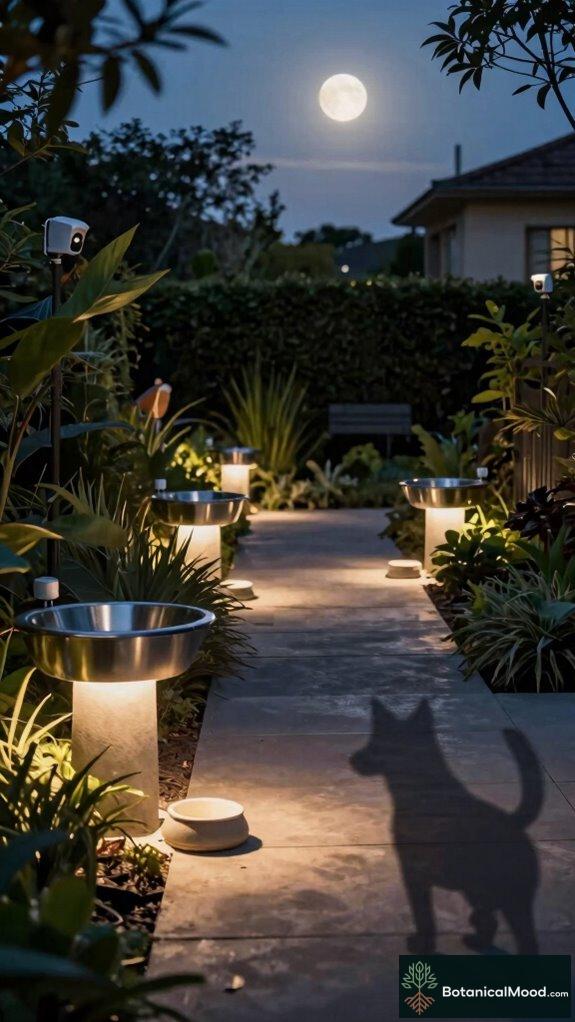
Bird baths equipped with motion-activated lighting create a practical, wildlife-friendly hydrological feature that attracts visiting birds while enhancing yard security after dusk; I describe how dedicated installations merge irrigation aesthetics with surveillance, guiding your setting toward integrated sensor ecosystems. Motion sensors illuminate splash zones, drawing species such as Calidris arenaria? (shorebird relatives) and Turdus migratorius (American robin) to shallow basins, while giving gardeners real-time alerts via Wi‑Fi modules. Choose stainless steel basins, UV-stable finishes, and frost-proof ceramic bowls, pairing with Coop Tender predator sensors for layered protection. Safe garden lighting protects nocturnal bats from disorientation while allowing them to hunt insects attracted to your water features.
| Zone | Sensory Imagery |
|---|---|
| Basins | Moonlit ripples, warm glow |
| Perches | Shadowed angles, guided silhouettes |
| Pathways | Gentle brightness, safe traversal |
| Plants | Nectar-friendly margins, pollinator halos |
FAQ
How Silent Are These Motion Sensors During Nighttime Hours?
They’re extremely quiet at night, barely audible, because most predator and solar motion sensors rely on passive infrared or low-noise electronics. I design around silent alerts, so you stay informed without disturbing your flock or neighbors.
Can Lights Run on a Solar-Only Power Setup Year-Round?
Yes, lights can run on solar-only year-round with ample panels and a capable battery. I once powered a shed through a prairie winter, storing sunpower like coins for storms, and the coop never dimmed when days shortened.
Do Sensors Distinguish Between Humans and Predators Effectively?
Yes, some sensors distinguish humans from predators using advanced infrared patterns and AI analytics, plus heat signatures and motion profiles; but accuracy varies by model, environment, and calibration, so I’d test and fine-tune settings with real scenarios.
What Maintenance Keeps Cameras and Sensors Reliable Long-Term?
I’ll keep cameras reliable by清 maintaining lenses, updating firmware, and testing angles—think micro-adjustments and weatherproof seals; I regularly clean sensors, back up configs, and stagger power cycles, so innovation stays sharp and interruptions stay minimal.
Are There Allergy-Safe Lighting Options for Hens?
Yes, I’d choose allergy-safe lighting like low-EMF, flicker-free LEDs labeled “gentle spectrum,” avoiding glare. I’ll test dim, warm tones at dawn/dusk to reduce stress, while integrating smart motion sensors for birds’ comfort and security.
References
- https://cooptender.com/products/chicken-coop-door-predator-motion-detection-module
- https://www.gonebroody.com/collections/predator-motion-detection
- https://www.backyardchickens.com/threads/motion-sensor-light-alarm-recommendations.1552423/
- https://www.fastlightingsupply.com/best-light-for-chicken-coop/
- https://www.youtube.com/watch?v=a47ai-jMQRk
- https://incubatorwarehouse.com/products/autocoop-laylight2-chicken-coop-automatic-led-light-w-timer-for-egg-laying-hens