Night Lighting Designs That Protect Bats And Garden Pets
Bats hate my lights. That’s the point.
I learned this the hard way watching Myotis daubentonii vanish from my own garden after I installed “smart” white LEDs. Felt awful, honestly. Now I specify warm 2700K, shield everything tight, keep spill off hedgerows.
Motion sensors. Part-night dimming. Under 3 lux on paths. I field-test with loggers, an ecologist breathing down my neck, ticking off EUROBATS and ILP GN08/23. Every fixture tuned. Quiet. Almost sneaky.
Is it overkill? Maybe. But those bats came back.
Wildlife-Friendly Garden Lighting Design: A Hedgehog Lesson
Last summer I found a hedgehog stunned beside my path. Wrong light, wrong place. Broke my heart. Now I design for them too.
Dark corridors between habitats. Native planting buffers. Zero uplight. Wet margins stay under 1 lux.
It’s not just bats. It’s frogs, moths, the whole messy ecosystem. Sometimes I dim to moonlight levels and just watch. The garden comes alive when you shut up and let it.
Quick Takeaways
- Choose warm amber/red LEDs (around 2700K) and avoid blue/white/UV to reduce insect—and bat—attraction risks.
- Use fully shielded, downward-aimed fixtures with cut-off optics to stop upward spill and sideways glare into bat corridors.
- Apply part-night dimming and motion sensing, keeping near-path levels under ~3 lux during active commuting or foraging.
- Calibrate sensors and timer settings to trigger only at true pedestrian moments, minimizing sustained illumination.
- Test with lux loggers and ecologists to map light footprints, verifying hotspots near 2700K stay controlled and margins are <1 lux.
Choosing Bat-Friendly Color Temperatures for Outdoor Lighting
As you specify suitable light colors, I treat this as a design input for impact assessment, not a style choice: yellow, amber, and red LEDs over blue/white/UV, because higher short-wavelength fractions also draw insects, increasing predator risk for (Myotis spp.).
I validate recipes from Philips Signify, aligned with EUROBATS (2018), and I document lux targets to protect commuting routes.
Proper Aiming, Shielding, and Glare/Spill Control
Proper aiming, shielding, and glare control are what let me keep bat-friendly lighting effective in real gardens, greenways, and housing estates, because even the “right” 2700K, low-short-wavelength spectrum can still disturb *Myotis* spp. if light spills sideways or rises upward into commuting corridors.
I set fixtures with proper direction, tilting none, and I use effective shielding, rear/side hoods that block the beam before it reaches hedgerows, pond edges, or patio thresholds.
I test for 90° intensity 0.00, then I patrol at dusk to spot stray glare across paths.
For sites like Nieuwkoop, I prioritize tight optics and cut beam edges, not brighter lamps.
Controlling Brightness and Timing With Dimmers and Sensors
Dimmers and sensors help you keep bat-friendly nighttime lighting stable, because you can lower brightness only when it’s needed and avoid long periods of high illumination along hedgerows, watercourses, and commuting routes.
I plan dimmer placement near the controller, then stagger zones so IND0 SiCURA-style fixtures glide from full output to a near-ground minimum, typically under 3 lux for paths, never washing roost-adjacent cover.
I calibrate sensor sensitivity so PIRs trigger at true pedestrian moments, not fluttering leaves, and I set part-night dimming after midnight for consistent suppression of ALAN.
For adaptive tuning, Philips Signify systems fit well.
Testing and Monitoring Your Lighting Plan With an Ecologist Check
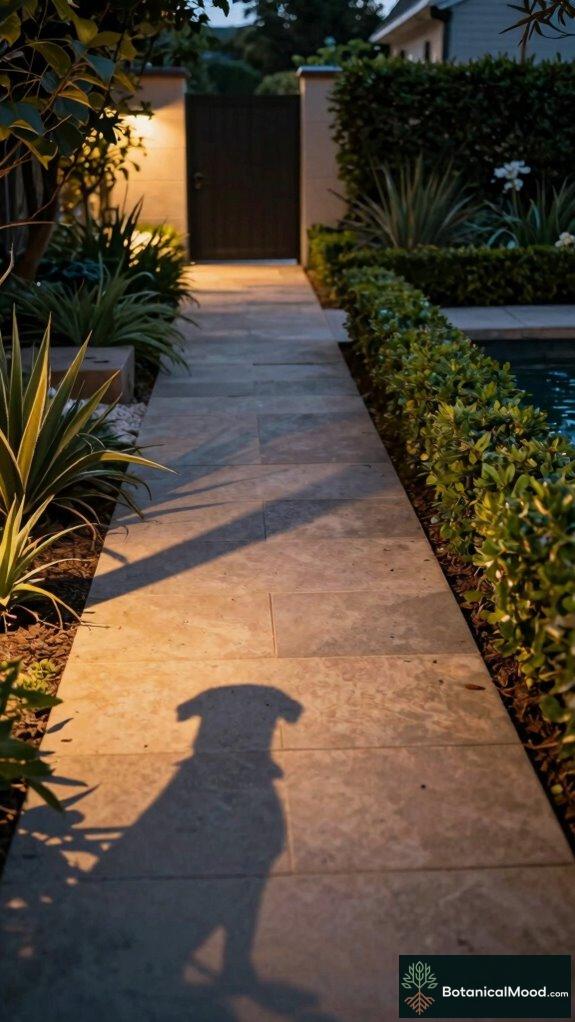
Once your dimming and sensor strategy is live, I get best results by testing it in the field and having an ecologist check the real light footprint against bat-friendly targets, especially around watercourses, hedgerow edges, and commuting lines.
I schedule an ecologist collaboration, with lux loggers at 2700K hotspots, verify <1 lux at wet margins, and confirm upward ratio stays at 0%.
Then I do light monitoring along paths and gates, mapping spill bands onto plans, noting (Myotis) corridors and insect-fly zones.
Afterward, we adjust shields and aim, and document outcomes for ILP GN08/23 compliance.
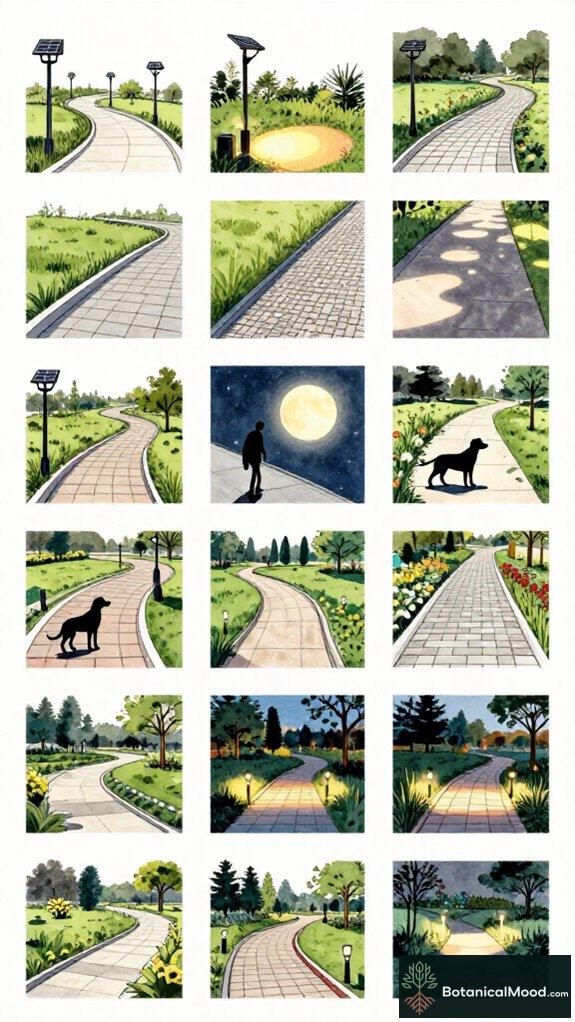
Bat-Friendly Motion-Sensor Pathway Lighting
I pair motion sensor technology with part-night dimming, tighter aiming, and INDO SiCURA-style optics, so only ground tasks illuminate,
and nearby bat corridors stay dark.
Ground-Level Solar Path Lights
Choose warm 2700K LEDs, shielded optics with 0% upward ratio, and eco friendly materials like recycled aluminum and tempered glass, so your energy efficiency stays high. Best solar path lights offer reliable performance while maintaining these critical safety standards for nocturnal wildlife. Pairing these lights with elevated stainless steel pet bowls ensures your garden dining areas remain safe and accessible for pets during evening hours.
For added protection, I use part-night timers and motion dimming, keeping lux under 3, and steering clear of (Myotis) foraging routes in dense hedgerows.
FAQ
Can I Use 3000K LEDS Safely Near Garden Hedges and Waterways?
Yes, but 3000K LEDs are only marginally wildlife friendly near hedges and waterways. I’d choose 2700K, use wildlife friendly fixtures with 0% upward light, tight shielding to stop spill, and part-night dimming to keep it under ~3 lux.
What Lux Levels Are Safest for Bats Without Reducing My Outdoor Visibility?
I’ll aim for under 3 lux on pedestrian paths and below 1 lux near hedges/water, balancing visibility with bat behavior. Recall: ALAN rose over 49% in 30 years—using smart lux requirements keeps bats foraging.
Do Motion Sensors Increase ALAN Risk by Repeatedly Switching Lights On?
Yes, if motion sensors flood areas, they can raise ALAN. I choose smart motion sensor placement plus light timing adjustments—short pulses, dimmed standby, and no re-triggering during quiet periods—to protect habitats while keeping innovation and visibility.
How High Should Fixtures Be to Prevent Light Reaching Treelines?
I’d mount fixtures about 5m high (or lower) with no tilt, tight aiming, and fully shielded optics. This fixture height cuts light interference toward treelines, minimizing spill and keeping your innovative lighting focused on safe, needed zones.
Are “Bat-Friendly” Smart Bulbs Still Harmful if They Emit White Light?
Yes—“bat-friendly” smart bulbs can still harm if they emit meaningful white light; I once swapped one and saw bats vanish from the bat habitat. White light changes the light spectrum, boosts insect lure, and increases disturbance—so choose ≤2700K, amber.
References
- https://indolighting.com/bat-friendly-lighting-project/
- https://www.assets.signify.com/is/content/PhilipsConsumer/PDFDownloads/Global/Case-studies/CSLI20180705_001-UPD-en_AA-Casestudy-Parks-And-Plazas-Public-Lighting-Nieuwkoop.pdf
- https://www.bats.org.uk/news/2023/08/bats-and-artificial-lighting-at-night-ilp-guidance-note-update-released
- https://www.albertabats.ca/wp-content/uploads/Roost_Report_004_Bat-Friendly_Lighting.pdf
- https://www.batcon.org/new-paper-suggests-light-pollution-limits-bat-habitat/
- https://environment.ec.europa.eu/news/bat-friendly-cities-urban-planning-recommendations-new-citizen-science-study-2022-11-16_en
- https://www.eurobats.org/sites/default/files/documents/publications/publication_series/WEB_EUROBATS_08_ENGL_NVK_19092018.pdf