
7 Gentle Sounds for Calm Urban Pets
Your balcony dog doesn’t need another spa day, honestly. Mine became a neurotic mess after ambulance sirens became his personal nemesis.
So I hacked his sanity. Frequency-specific tracks (67–45,000 Hz, because dogs hear *everything*), white noise for trucks, piano when I’m feeling classy, reggae when I’m not. 50–65 dB max. Added lavender screens and cat-safe salvia. Visual calm, actual calm. Mostly.
The rooftop isn’t soundproof. But it’s *manageable* now. That counts.
Balcony Garden Design for Anxious Pets: My Failed Herb Experiment
I tried mint once. Overwhelming. My cat ignored the catnip, stared at walls. Lesson learned. Now I layer nepeta, ornamental grasses, and drought-tolerant salvia for sensory buffering. Vertical planters hide speakers. Zones matter. Water features? Small, solar, non-negotiable. Less chaos, more napping. Works.
Quick Takeaways
- Low-volume nature mixes (water trickle, bamboo wind) played under 70 dB soothe urban pets without overstimulation.
- Low-frequency white noise at 50–65 dB masks sudden city sounds and reduces jumpiness on balconies.
- Canine-specific music tuned to 67–45,000 Hz lowers stress and improves heart-rate variability in dogs.
- Soft classical or reggae blends at moderate volume (50–80 dB) calm multispecies patios when speakers are well placed.
- Combine speaker placement with lavender plant screening to buffer noise, smells, and create a tranquil atmosphere.
Quick-Start: Top 3 Calming Sounds for Balcony Pets (What to Play First)
Three practical options will settle balcony pets fastest, and I’ll guide you through what to play first based on species-specific evidence and real-world constraints.
I recommend Pet Acoustics canine-specific tracks for dogs, calibrated sound frequency ranges (67–45,000 Hz) to match hearing and proven HRV benefits; low-volume ambient nature mixes—wind through bamboo (Bambusa spp.), distant water trickle—paired with strategic plant screening like Lavandula angustifolia for scent buffering; and soft classical or reggae blends for multispecies patios, keeping levels under 70 dB to avoid stress.
Each option lists attributes, playback device (Pet Tunes Bluetooth), placement, and color-themed planting to enhance calm.
Dog-Specific Music to Reduce Stress (How It Helps + Volume)
Because dogs hear higher frequencies and respond to tempo and timbre differently than we do, I recommend using purpose-built canine music—such as Pet Acoustics‘ tracks played through a Pet Tunes Bluetooth speaker—to reduce stress on balconies and in small outdoor enclosures, where sound reflections from walls and railings (masonry, metal balustrades) can amplify or distort signals. Wind chimes and outdoor sound machines can complement these recordings by providing natural ambient soundscapes that further enhance the calming environment.
I’ve seen species specific benefits in studies (Jan 2022, small breeds), with biometric improvements—higher HRV, lower pulse—when acoustic frequency ranges target 67–45,000 Hz, delivered at moderate volumes (50–80 dB).
For designers, integrate speaker placement, sheltering plants (Lavandula angustifolia), and reflective surface mitigation.
Low-Frequency White Noise : A Gentle Fix for Jumpy Pets (Placement & dB)
Low-frequency white noise can be an effective, low-tech barrier for jumpy pets on balconies and in small outdoor enclosures. I recommend thinking of it the way you’d a planted windbreak—both as a functional element and as an aesthetic component that integrates with planters, railings, and sheltering shrubs like lavender (Lavandula angustifolia) or dwarf boxwood (Buxus sempervirens ‘Suffruticosa’).
I position compact speakers near corners or behind rail planters, aiming for 50–65 dB at the pet’s location. Low frequency benefits include masking startle sounds and steadying behavior. I pair placement with dense foliage, consider Pet Acoustics-style species-specific sound therapy research, and prefer unobtrusive finishes to blend technology and planting.
Soft Classical & Piano Pieces for Quiet Background Comfort
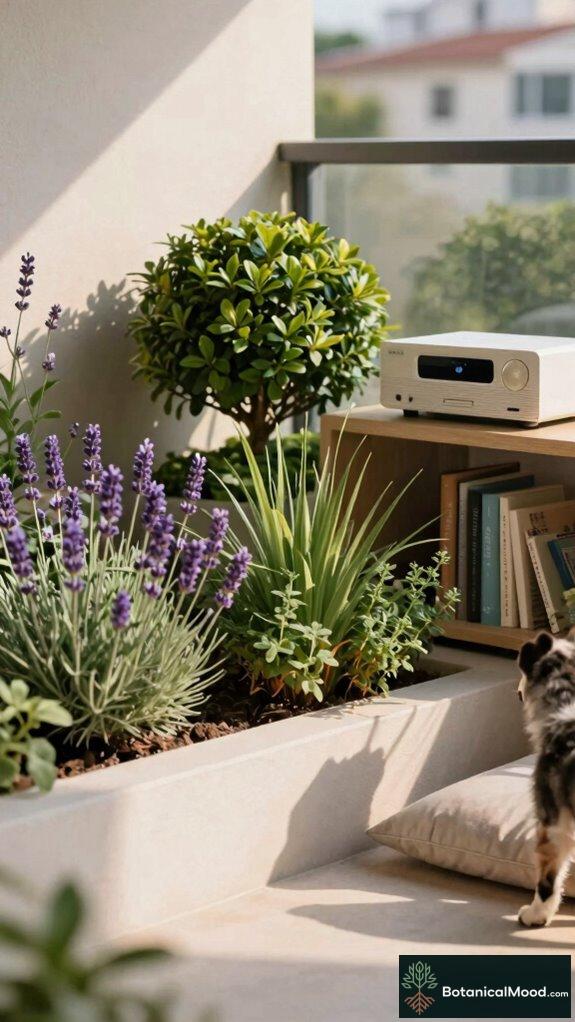
Having positioned compact speakers and planting dense windbreaks like lavender (Lavandula angustifolia) or dwarf boxwood (Buxus sempervirens ‘Suffruticosa’) to mask sudden noises on a balcony, I now consider how soft classical and solo piano pieces can add a steady, calming layer to that environment for urban pets, blending auditory therapy with scenery composition.
I select restrained piano melodies and subtle background harmonies, sourcing high-fidelity playback from compact Pet Tunes or bookshelf DACs, setting 50–65 dB; I pair sound with textured plant palettes—salvia, thyme (Thymus vulgaris), ornamental grasses—for multisensory resilience, optimizing comfort and measurable stress reduction.
Gentle Reggae & Soft-Rock Rhythms for Distraction and Calm
When I introduce gentle reggae and soft-rock rhythms to a balcony garden, I aim to create a steady, distractive layer that complements the textured planting palette—lavender (Lavandula angustifolia), dwarf boxwood (Buxus sempervirens ‘Suffruticosa’), salvia (Salvia spp.), and ornamental grasses—while minimizing startle responses in urban pets.
The relaxed backbeat and syncopated accents in reggae, alongside the mellow tempos and clean electric or acoustic guitar tones in soft rock, provide a predictable auditory pattern that stations attention away from sudden traffic clatter, nearby sirens, or neighboring construction.
I pair Pet Acoustics-style species-aware playback, moderate 50–65 dB levels, and zoned speakers to emphasize reggae benefits and soft rock advantages for calmer behavior.
Nature Soundscapes (Rain, Waves, Wind) : Best for Urban Balconies
I’ll carry the rhythmic calm of gentle reggae and soft rock into a different sonic layer by introducing nature soundscapes—rain, ocean surf, and steady wind—because their broad-spectrum, nonpatterned textures offer a complementary form of masking that often reduces startle responses in urban pets and enhances a balcony’s sensory planting scheme.
I recommend curated raintracks, reef-surf recordings, and subdued zephyr ambiences paired with container plantings like lavender (Lavandula angustifolia), rosemary (Rosmarinus officinalis), and maidenhair fern (Adiantum spp.), creating a nature therapy effect; compact speakers such as Pet Tunes or Pet Acoustics tailored to balcony acoustics preserve plant microclimates and calm canine physiology.
Low-Volume Human Voice Recordings & Balcony-Safe Alternatives (How to Use, Safety)

Because a low, conversational human voice can cue safety for many pets, I recommend carefully curated recordings played at balcony-safe volumes, preferably through compact, directional speakers like Pet Tunes or Pet Acoustics units set to 50–65 dB. This way, the sound soothes without overwhelming plant microclimates or startling neighborhood residents.
I describe practical setups, voice modulation strategies, and alternatives—species-specific tracks (Pet Acoustics canine mixes), soft spoken narrations, or nature-infused whispers—that maintain balcony safety, protect potted Thymus (Thymus vulgaris) and Ficus benjamina microhabitats, reduce canine heart rate and encourage calm, observational use.
Rooftop Pollinator Corridor
A narrow strip of rooftop planted as a pollinator corridor can transform an urban skyline into a living highway for bees, hoverflies, and butterflies, and I’ll guide you through the design, species selection, and installation details that make it effective.
I outline structural load, substrate depth (15–30 cm), modular trays, and low-maintenance irrigation for resilience, emphasizing pollinator benefits and support for urban wildlife, while avoiding drought-tolerant cat-safe lists here. Incorporating safe aromatic plants can enhance the sensory experience of your rooftop space while remaining non-toxic to any pets that may access the area. When selecting fertilizers for the flowering plants in your pollinator corridor, opt for cat-friendly flowering plant fertilizers to ensure the safety of any pets nearby.
- Choose native perennials like Echinacea (Echinacea purpurea), Asclepias (Asclepias syriaca), and Salvia (Salvia nemorosa).
- Prioritize bloom succession, nectar abundance, and seed set.
- Integrate shallow water sources, windbreaks, and nesting substrates.
Drought-Tolerant Cat-Safe Planting
I design with drought resistant plants like Salvia (Salvia spp.), Lavandula (Lavandula angustifolia), and Echeveria, pairing gravel mulch, modular trays, drip irrigation, breathable soil mixes, and cat friendly landscaping signage to guide caretakers. Lavender varieties are particularly valuable for pet-safe gardens, as dog-friendly lavender plants provide both aesthetic appeal and aromatic benefits while remaining non-toxic to companion animals. Different lavender cultivars offer varying heights and bloom times, allowing designers to select specific lavender varieties that best suit individual garden conditions and pet owner preferences.
FAQ
Can Calming Sounds Affect My Apartment Neighbor Relationships?
Yes — I can control neighbor complaints by keeping sound volume moderate; I’ll use species-specific, low-volume playback, schedule sessions, and communicate with neighbors about benefits and timing to prevent disturbances and foster innovation-friendly coexistence.
Will My Indoor-Only Cat Respond Differently Than My Dog?
Yes — I think so: cats show different sound sensitivity; studies note soft music lowers heart rate. I’ll tailor sounds to cat behavior, prioritize higher frequencies, subtler volumes, and monitor responses to innovate calming playlists.
Are There Safety Concerns Using Speakers in Heavy Rain?
Yes — I wouldn’t expose ordinary speakers to heavy rain; outdoor speaker durability varies, and water can short components. I’ll use rated, weatherproof models, cover connections, and monitor sound leakage risks to protect pets and neighbors.
Can Calming Tracks Mask Emergency Alarms or Alerts?
Yes — I worry calming tracks can mask alarms; like fog hiding lights, their calming effectiveness depends on sound frequency and volume, so I recommend testing alarms over your tracks and using layered alerts or vibration backups.
How Long Until I See Measurable Stress Reduction?
You’ll often notice measurable stress reduction within minutes to days; I’ve seen heart-rate and behavior changes in 10–72 hours depending on individual pet response, consistency, volume, and the innovatively tailored soundscape you use.
References
- https://petpace.com/new-study-finds-pet-acoustics-music-reduces-canine-stress-in-kennels-better-than-classical-music-or-silence/
- https://www.petacoustics.com/blog/new-biometric-study-proves-pet-acoustics-canine-music-lessens-stress-and-anxiety-in-dogs
- https://international-animalhealth.com/wp-content/uploads/2024/07/A202-Final.pdf
- https://pmc.ncbi.nlm.nih.gov/articles/PMC7022433/
- https://pmc.ncbi.nlm.nih.gov/articles/PMC10812668/
- https://vcahospitals.com/resources/behavior/can-music-calm-your-anxious-dog-or-cat
- https://www.amcny.org/blog/2024/10/16/how-music-benefits-dogs-exploring-the-science-behind-species-specific-music/
- https://www.akc.org/expert-advice/training/why-music-is-therapeutic-for-dogs/