I learned the hard way that bare fences are basically bird deserts.
So I tore them out. Packed in hawthorn, elder, hazel. Let them fight for space at 60cm apart until they knotted into impossible tangles. Now? Sparrows vanish inside. Bees lose their minds over the pyracantha.
That 1.5m height? Non-negotiable. Anything lower and cats treat it as a buffet line. Speaking of which, my “cat moat” is just gravel and bitter honesty. They hate it. I grin.
The privet tried to invade once. I showed no mercy.
H2: Wildlife Corridor Design Mistakes That Cost Me Two Nesting Seasons
My first hedge died. Classic. Planted a solid wall of single-species hawthorn, zero gaps, zero thinking. The wrens arrived. Then starlings bullied them out. No escape routes. No layers.
Ground level? Bare soil. Should have tucked in dog violets and wood anemone for pollinator fuel. Instead I got weeds. Depression gardening, I call that spring.
Now I alternate structure. Thorny base, blossom middle, scattered gaps like secret doors. Mature height around 2.5m. Blackbirds nest low; robins high. everybody wins.
Except the neighbour’s cat. Still working on that.
Quick Takeaways
- Use dense mixed native thorny hedges (e.g., hawthorn, elder, thorny roses) for shelter, nesting cover, and insect foraging.
- Space plants 60–90cm apart and keep hedges 1.5–3m tall to encourage interlocking, continuous wildlife movement.
- Plan maintenance with 1–2 light cuts yearly to retain dense cover near livestock while preserving secure interlock zones for birds.
- Add wildlife culverts beneath hedges with 15–20cm openings to enable safe passage for small mammals and reptiles.
- Keep pet-safety in mind with a narrow “no-pass” strip and low border planting, using non-toxic berry species where possible.
Plan Wildlife Corridor Planting With Thorny Hedge Rows
When you plan a wildlife corridor planting with thorny hedge rows, I’d start by choosing a mixed native hedge design that functions as both a movement route and a year-round resource, because hedgerows provide shelter and nesting habitat for farmland birds, plus food in the form of berries, flowers, pollen and nectar, along with predatory invertebrates like spiders and beetles that help balance pests.
Next, I shape my corridor design around hedgerow ecology, staggering species like (Crataegus monogyana), (Corylus avellana), (Sambucus nigra), and (Rosa spp.), then layering heights to guide hazel dormouse movement and bird foraging. Thorny plants also serve as non-toxic garden protection against unwanted wildlife while maintaining ecological balance.
I aim for 1.5–3m structure, set plants 60–90cm apart, and schedule light, 1–2 cuts yearly.
Choose the Best Thorny Hedge Species for Birds and Safety
To get both high-value bird benefits and dependable safety along your wildlife corridor, I pick thorny hedge species that deliver berries, sheltered nesting structure, and a physical deterrent to stock, so the corridor works year-round without you constantly patching gaps.
I favor hawthorn (Crataegus monogyana) for dense, twiggy cover and insect-attracting blossoms, plus pyracantha for bright hips, and mixed native roses for layered thorny benefits. Holly shrubs rank among the top safe thorny options for creating protective barriers while supporting diverse bird species.
For practical bird safety, I set taller sections around 1.5–3m, and where livestock roam I thicken hawthorn and elder (Sambucus nigra), then plan minimal, wildlife-friendly cutting.
Holly shrubs also provide year-round wildlife shelter with their evergreen foliage and vibrant berries that sustain birds through winter months.
Space and Train Thorny Hedges to Form Strong Boundaries
I space and train my thorny hedges deliberately, so they form a tight, reliable boundary that still functions as a wildlife corridor for farmland birds and predatory invertebrates; in practice, I plant mixed native thickets—hawthorn (Crataegus monogyna), elder (Sambucus nigra), and thorny roses—at a density that lets branches interlock within a few growing seasons, rather than leaving long gaps that livestock, wind, and repeated browsing exploit.
I aim for consistent, year-round boundary aesthetics, then I use thorny maintenance schedules to keep the lattice living, not bare. A garden pitchfork makes clearing fallen branches and maintaining hedge bases far more efficient than hand tools alone. Hawthorn trees are among the best hawthorn varieties for establishing secure wildlife hedges, as their dense growth naturally creates the protective interlock zones essential for nesting birds.
- Interlock zones first, then thicken at hedge shoulders
- Train leaders horizontally, using soft ties and spacing cues
- Cut 1–2 times yearly, never hard in nesting season
- Fill gaps quickly with staggered saplings (Crataegus, Rosa, Sambucus)
Set Up Wildlife-Friendly Boundary Management for Cats and Pets
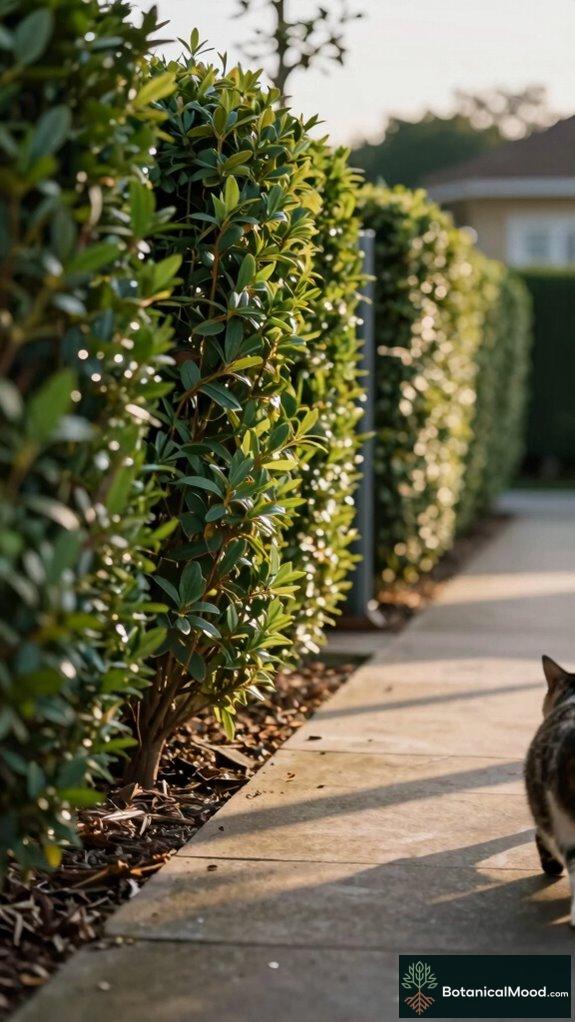
A practical boundary management plan lets thorny hedges stay both secure for pets and permeable for wildlife, so you get safer roaming without stripping the habitat benefits.
I start with feline safety: define a narrow “no-pass” strip, then plant mixed hawthorn (Crataegus monogyna), pyracantha, and rose alongside a low mesh inner fence, posts staggered for sightlines.
Next, I keep boundary aesthetics crisp, using trained stems, 1.8–2.5m height, and discreet leaf litter gaps for hedgehogs and beetles.
Hawthorn trees like Crataegus monogyna are among the top hawthorn varieties recommended for creating thorny hedges that provide excellent wildlife protection while maintaining secure boundaries.
Finally, I install quick-release cat enclosures at gateways, and leave occasional 15–20cm wildlife culverts under hedges.
Choose Cutting Timing That Protects Nests and Corridor Use
When you cut your thorny hedge out of season, you don’t just tidy it—you can remove nesting material and interrupt the corridor function that hedgerows provide for farmland birds, predatory invertebrates, and dormouse movement, so I plan timing before I pick up any tools.
I follow a cutting schedule that prioritizes nesting safety, typically avoiding major trims during spring breeding and early summer. Instead, I do light, selective shaping after leaf-out checks, then schedule a main cut late summer to early autumn, when activity drops and structure stays corridor-ready.
- Quiet nesting windows protected
- Corridor continuity for (Muscardinus avellanarius)
- Innovation via micro-timing, not hard rules
- Hawthorn (Crataegus monogyna) regrowth benefits
Avoid Common Hedge Problems Like Saplings, Fencing, and Invasives
To keep a thorny hedgerow functional as a wildlife corridor—while also staying practical for boundary control and long-term maintenance—I address three common problems early: volunteer saplings, livestock penetration, and invasive or overly aggressive plants.
First, I practice sapling management, coppicing or spot-digging volunteers before they root into gaps, because vigorous seedlings choke the planned mix of Crataegus monogyna (hawthorn) and pyracantha.
Second, I design livestock-ready thorn density, so breaches don’t become shortcuts through the hedge line.
Third, I monitor invasive species, removing (Ligustrum vulgare) and other problem spreaders early, then replanting with locally sourced native shrubs for resilient, corridor-ready structure.
Thorny Hedge Wildlife Passages
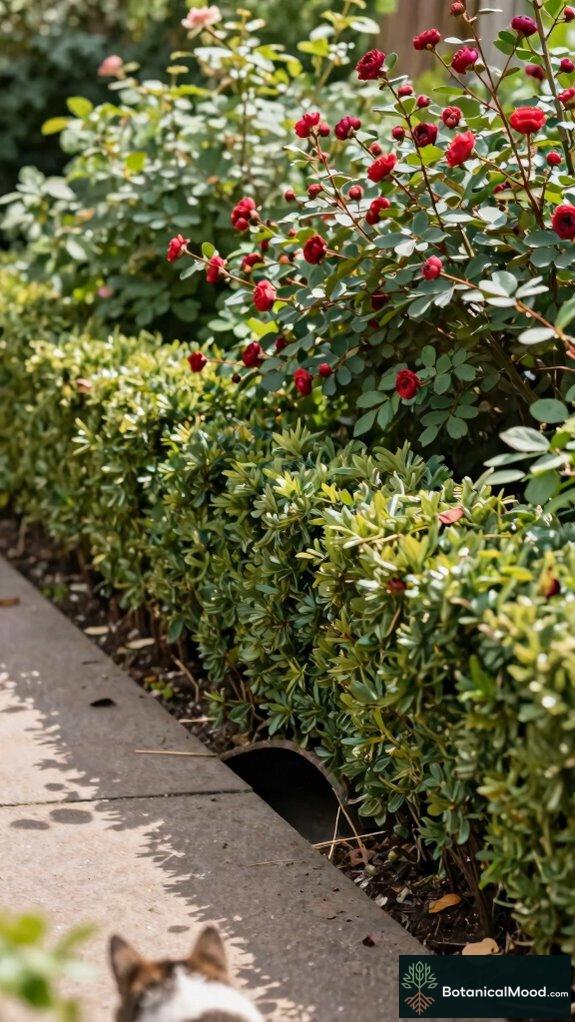
Wildlife still needs safe movement along your boundary line, so after I’ve handled saplings, livestock penetration, and invasive spreaders, I build thorny hedges that include deliberate wildlife passages—small, well-placed “gaps-by-design” or low-maintenance escape routes at ground level rather than accidental breaks.
These openings protect hedgerow biodiversity, letting hedgehogs, dormice, and invertebrate predators link up wildlife corridors between patches, even as hawthorn (Crataegus monogyna), rose (Rosa spp.), or pyracantha (Pyracantha coccinea) deter larger intrusion. Thorny barriers like these work similarly to natural dog deterrents by creating physical boundaries that discourage unwanted entry while maintaining ecological function. Well-designed hedges also provide essential shelter and nesting sites for garden birds and small mammals throughout the seasons.
- Keep passages 10–15cm high, 20–30cm wide
- Pair with dense scrubby margins for cover
- Avoid mowing through corridors, cut late, once
- Monitor with spring track checks
First Pet-Safe Thorn Patch
I recommend you begin your first pet-safe thorn patch as a deliberately controlled strip of mixed native hedging—typically hawthorn (Crataegus monogyna), with supporting species such as elder (Sambucus nigra) and pyracantha (Pyracantha coccinea)—set along your boundary where you want corridor value without creating accidental hazards for dogs that roam or owners who garden in that line daily; guarantee the patch is set back behind a narrow stock-proof edge, plus a low border planting that guides paws away. Layer thorny hedge benefits, berries, and insect life, prioritizing pet safety, by staging height 1.5–2m and mulching to reduce wandering access. When selecting plants for your hedging design, focus on non-toxic plant selection to ensure that any berries or foliage your pets encounter will not cause harm if accidentally ingested. Native hedging plants provide natural foraging habitat for local wildlife while maintaining a barrier that protects pets from venturing beyond designated garden areas.
FAQ
Can Thorny Hedges Safely Support Nesting While Blocking Cats?
Yes—thorny hedges can boost nesting safety while reducing cat predation. I plant dense hawthorn or pyracantha, keep gaps minimal, and use an inward “snag” layer with a low stock-proof barrier until shrubs thicken.
What’s the Best Location to Connect Hedges With Woodland or Parks?
Best location is where your hedges can bridge gaps between woodland and parks—along field edges, stream lines, and old trackways—so hedge placement keeps continuous wildlife pathways. I’d connect corners and overlook fences; Britain lost 118,000 miles since 1950.
How Long Until Thorny Hedges Become Effective Wildlife Corridors?
You’ll see real habitat benefits within 1–2 years as thorny plants leaf, flower, and shelter invertebrates. For strong wildlife corridor function, expect a growth timeline of 3–5 years, then it keeps improving with thicker, fruiting hedges.
Which Birds Actually Use Hawthorn and Pyracantha for Food and Shelter?
As dawn flickers, birds slip into hawthorn and pyracantha like living hedges. I’ve seen finches and thrushes nest there, feasting on berries and insects, while sparrows and robins shelter in dense spines.
How Do I Prevent Pets Accessing Berries Without Harming Wildlife Benefits?
I prevent pets reaching berries using pet deterrent strategies: thorny lower growth, thorny/woody border edging, and fruit-protecting netting panels that exclude pets but still let pollinators and birds access. I also place water bowls farther away to redirect curiosity.
References
- https://wildlife-matters.org/wildlife-matters-podcast/the-benefits-of-hedgerow-natures-corridors/
- https://hedgelink.org.uk/cms/cms_content/files/65_hedgerow_management_and_wildlife.pdf
- https://hedginguk.com/hedges-and-their-environmental-benefits/
- https://www.rhs.org.uk/plants/types/hedges/with-environmental-benefits
- https://www.fws.gov/story/wildlife-corridors
- https://www.woodlandtrust.org.uk/trees-woods-and-wildlife/habitats/hedgerows/
- https://besjournals.onlinelibrary.wiley.com/doi/full/10.1002/2688-8319.12209
- https://heartofenglandforest.org/news/why-are-wildlife-corridors-important